Hi! I’m Chloe. I’m studying in Cambridge for a degree in illustration and am aspiring to become a children’s book Illustrator.
Obviously I didn’t get to where I am over-night, and I remember how awkward and janky it felt to teach myself as I was figuring out the basics.
There were a few lessons I learnt which I think were more pivotal to my art than others, so I’ve outlined them here with the intention of helping new or developing artists.
1. YOU NOT NEED FANCY EQUIPMENT.
I know it feels like you need all the fancy equipment in order to create good art, but I promise you that is not the case.
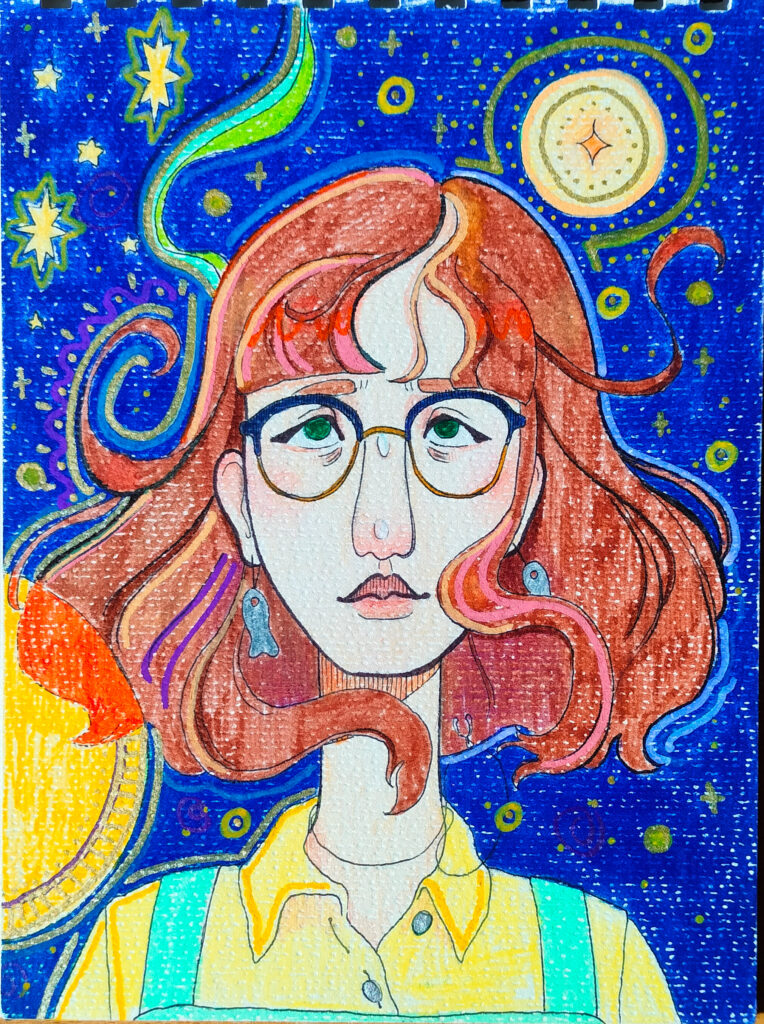
I made this self portrait on an old watercolour sketchbook, using half dried out Crayola pens, a few colour pencils, a low quality fineliner from B&M and cheap acrylic paint pens from The Works.
Art should not be a privilege. It should be accessible to everyone; so pick up those old crusty pens and put them to paper. It might be your best drawing yet!
There is a lot of pressure online from big content creators that you need the most expensive things on the market to make ‘good’ art- but the quality of your art is limited only by your skill level. Even if you own a set of Prismacolour pencils- some of the best on the market- if the only thing you can draw with them is a stick man, the only thing you have on your paper is a very expensive stick man.
However, I understand that when you’re first starting out it can feel nice and can even be motivating to have some good quality materials. I personally recommend that if you are going to splurge on anything, go in this order:
- Paper.
- A good quality sketchbook or paper pad will immediately elevate your work and make you feel more professional. sugar paper or cartridge paper are good options for affordable prices without sacrificing quality. I like to work on watercolour paper, even if I’m not using a water based medium. This is, however, a bit more expensive. I choose it because it’s sturdy and adds a texture that I like to my works, though your preference may be different.
- Brushes.
- a good set of brushes, if cared for properly, will last you a long time and will make painting feel much easier. Do some research into the sort of brushes that are typically used for your medium and why. Some will use finer fibre brushes (water based mediums usually) where as others will use thicker more rigid fibres (for example, oils and acrylics are often used with boar-bristle brushes).
- Media add-ins.
- This is slightly specific to painters and includes things like impasto paste, liquin, and linseed oil… I’ll talk about these in a later post.
- Medium.
- Medium is just a fancy term for what you are using to create your work; so pens, pencils, oils, inks, etc… the higher the quality your medium, the more pigment, the more vibrant your colours.
Some good brands to look out for that are affordable for their quality are Crawford and Black, Reeves, and Seawhite of Brighton, .
All in all, it does not take £100+ worth of materials to create a good setup for you to begin creating at a beginner or even intermediate level. Play around with what you’ve got before you bankrupt yourself with the whole of the artist market.
2. LEARNING IS NOT LINEAR.
Most people seem to think that learning is a straight line that goes continually up as you just keep getting better and better and better- but this isn’t true for anything. Not for maths, not for languages, not for science, not for art.
You will have plateaus where nothing improves, you will have pieces you hate or that don’t look how you wanted them to, you will have periods where you feel like your skills are regressing- but I promise this is all learning. you may feel like you aren’t, but it is all part of a larger process.
When you are learning, it is important to listen to the critiques you receive. There may be a few tough pills to swallow, but it’s important to remember that any critique you receive may be useful in you growing as an artist. If you’re drawing and someone says “hey, I think the nose might be a bit small.” or “I think the perspective might be off a bit.”, take that on board and give it a try. Other people can often see things you can’t.
3. KEEP A SKETCHBOOK (or a few…).
Keeping track of your progress is important for your growth. finding flaws in your old work, or things that you thought worked very well, are key to developing your skill AND your style.
The easiest way to do this is to keep a sketchbook, and If possible, date your works! I find that it is helpful to have one sketchbook dedicated to rough work like artist research, sketches, concepts, doodles and scribbles, etc, and another one for more refined works.
4. USE REFERENCES!!!
Whether you are first starting out or are further along in your journey- USE REFERENCES!!!
Use images of real people, objects, and places if possible. Try to use images you have taken, or draw from life. If not possible make sure the images you are using are high quality.
I will do a post in future outlining how to take good quality pictures, and how to crop them for use.
I would heavily discourage using generative AI. AI will create you an image, but it may skew the perspective, and colour, or even the basic form of what you’ve asked it to generate. Before you know it, the drawing you have in front of you has six fingers and eight toes with a chair that is mysteriously merged to be part of it’s leg.
5. START YOUR PORTFOLIO EARLY.
One thing I really regret is that I didn’t start my portfolio earlier. It is such a good way of making sure you don’t lose any of your work to time or moving between places.
Because I didn’t start earlier, I have lost a lot of my older works from when I was first starting, and while no they would not have made it into my professional portfolio today, they would have been a lovely addition to my personal one to track my progression through the years.
Leave a Reply